“Mag-carwash kaya ako?” Madaling ma-excite at bumili agad ng pressure washer. Pero iyon ang isa sa pinakamabilis na paraan para mali ang unang gastos.
Before the machine, answer this: ilang sasakyan ang target mong linisin bawat araw?
5 cars a day is different from 25 cars a day
Kung sideline sa bahay at 3–5 cars/day, iba ang duty cycle at setup na kailangan. Kung commercial operation na tuloy-tuloy, mas importante ang durability, water flow, hose reach, electrical supply at downtime.
Step 1: Check your water source
May direct line ba? Tank? Mahina ba pressure? Consistent ba ang supply? A pressure washer cannot fix a water source that cannot feed it properly.
Step 2: Check the power
Electric machines need a safe circuit and proper extension wiring. Gasoline units give more independence from outlets, but bring fuel, noise and maintenance considerations.
Step 3: Design the workflow
Think beyond “washer”: hose management, buckets, foam application, drying, vacuuming, drainage and where the next car waits. A fast machine inside a slow workflow still gives you a slow business.
Electric vs gasoline pressure washer
| Electric | Gasoline | |
|---|---|---|
| Best for | Home/small fixed setups | Higher-duty or outlet-independent work |
| Noise | Usually lower | Higher |
| Maintenance | Simpler | Engine maintenance required |
| Mobility | Limited by power source | More independent |
A real SAVG comparison
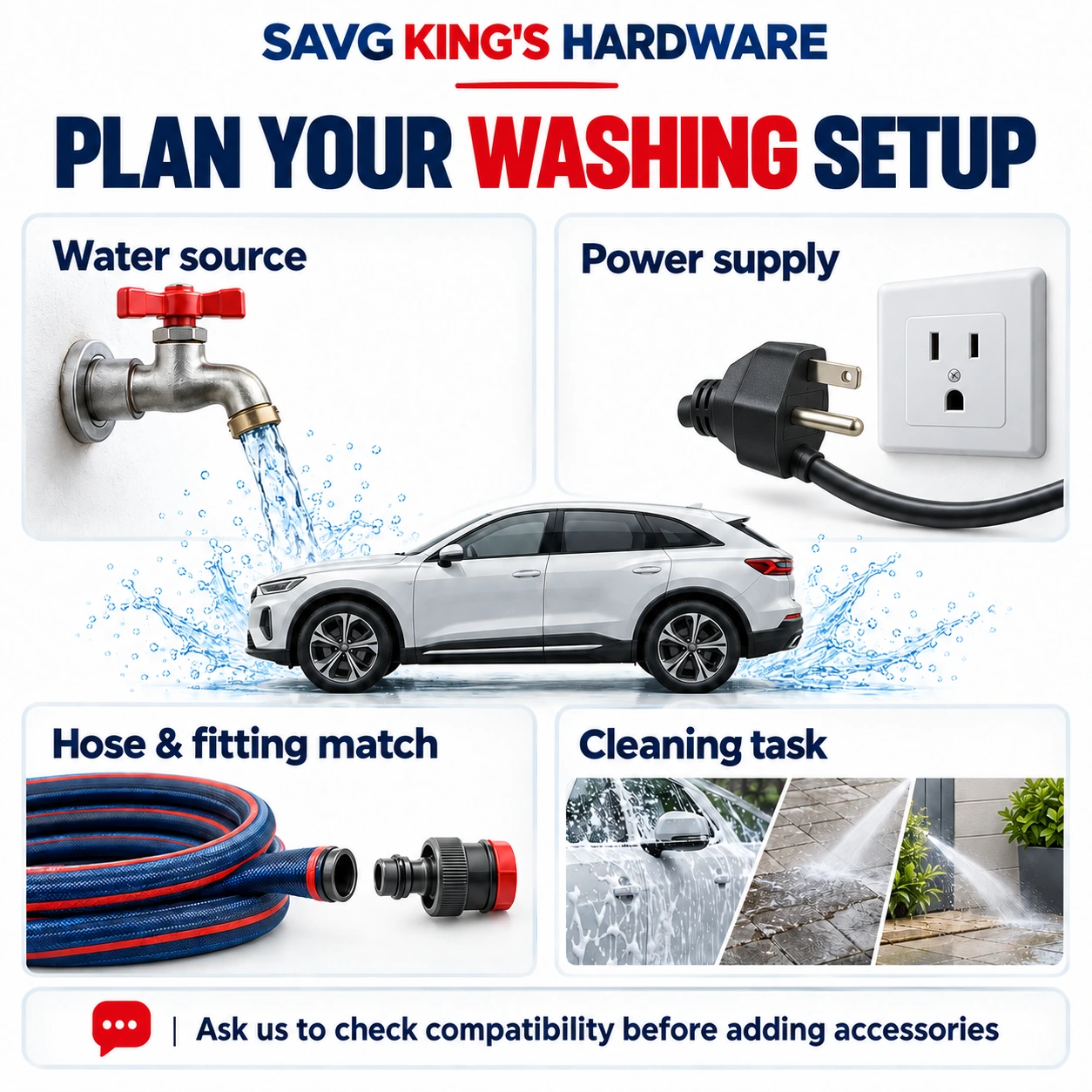
For lighter or compact setups, one current option is the Raijin RHPW1500 1500W induction pressure washer. For a heavier gasoline setup, SAVG also carries the Powerhouse PH-PW3000GAS 7HP 3000 PSI.
Those are not interchangeable purchases. The right choice depends on how many cars, how long the machine runs, your water source and whether you need mobility.
Example: design the carwash process before buying equipment
- Arrival and inspection: leave enough space for safe vehicle movement and access.
- Pre-rinse: verify water source capacity, hose reach and drainage.
- Wash: choose equipment suitable for expected daily volume and duty cycle.
- Rinse and finish: plan clean towels, drying area and wastewater handling.
- Reset: clean the work area and prepare for the next customer without blocking traffic.
A shop washing five cars over a day and a site processing 25 cars continuously may need different equipment durability, plumbing and staffing. Ask the manufacturer for flow rate, rated pressure, duty cycle and service requirements before comparing machines solely by PSI.
Where the wrong purchase costs money
A machine with impressive peak pressure may be unsuitable if the water source cannot feed it. An electric washer may be practical in a fixed bay with a compliant circuit; a gasoline unit introduces ventilation, fuel and engine maintenance requirements and must not operate in unsafe enclosed areas. Check local permits, drainage and wastewater handling before committing to a business location.
For a starter setup, read your Raijin RHPW1500 product specifications and compare with a higher-duty Powerhouse gasoline pressure washer only after identifying flow, source, volume and running conditions. Don’t choose based on brand or PSI alone.
Before you spend
Write down: target cars/day, source of water, available electrical circuit, space, drainage, and your starting budget. That one sheet will tell us more than asking “Ano pinakamalakas na pressure washer?”
Bring that plan to SAVG—or use the Tool Advisor—and build the business setup from the job backwards.